The facility is flexible in terms of peptide number (the simultaneous synthesis of up to 120 peptides is possible), peptide quantity (2 mg to about 1 g), peptide purity (up to 99% peptide purity), peptide length (up to about 40 amino acids) and peptide structure (linear, cyclic, branched, hybrid structures, etc). Peptides may contain non-natural amino acids, lipophilic groups like a palmitoyl or cholesteryl moiety, PEG-spacers, an azide or DBCO group for click chemistry applications, isotope-labeled amino acids or affinity tags like biotin or metal chelating groups. In addition, the peptides may contain labels for sensitive and flexible detection like fluorescent groups.
We can also synthesize peptide libraries. Peptide libraries are still an underestimated tool to identify new (lead)structures in medicinal chemistry. Diversity of structures can be generated easily and the possibility of different structures is almost infinitive. Generation of these (often millions) of peptide structures is relatively straight forward because known technology in peptide synthesis can be used and the compartmentalization of structures as one-bead-one peptide systems can easily be established by using the proper resin beads for synthesis.
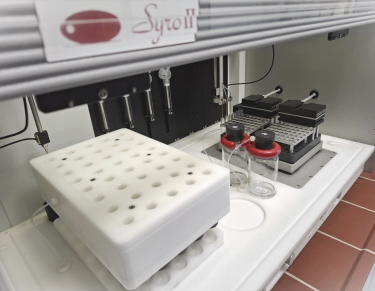
The facility routinely uses UPLC-MS and MALDI-TOF analysis for quality control of the products, has equipment for and extensive experience with protein sequencing, large scale peptide purification, peptide release and stability studies and HLA-peptide binding experiments.
We have been involved in many successful research projects in the past in a variety of medical areas, both within and outside the LUMC. In those projects our role has been to design and synthesize peptides and peptide-like structures that were subsequently tested on their intended bioactivity by our customers.
To order peptides, download the peptides ordering form here and send the completed form to immuno-peptide_facility@lumc.nl. Please contact us when you have questions or for further information.
Furthermore, we have ample experience with the production of MHC class I tetramers from the commonly studied human and mouse alleles labeled with PE, APC or Alexa containing a peptide of choice. If you need assistance with the production of tetramers, please contact us at c.l.m.c.franken@lumc.nl or r.a.cordfunke@lumc.nl
CONTACT:
For peptides: Robert Cordfunke or Natasja Dolezal
For tetramers: Kees Franken or Robert Cordfunke
Department of Immunology | Room L-03-050h
Leiden University Medical Center
Albinusdreef 2
2333 ZA Leiden
The Netherlands
E: immuno-peptide_facility@lumc.nl
T: +31 (0)71 52 64775